

It's remarked in almost every pre-owned Rolex listing. "Complete set." "Box and papers." "Watch only." The terminology is consistent, but what it means for price — and whether it should affect your buying decision — is often less clear than sellers suggest.
We've been buying and selling pre-owned Rolex watches since 2000. The box and papers question comes up on almost every transaction. Here's our position.

What "Box and Papers" Actually Means
The box refers to the original retail packaging — the outer shipper, the inner presentation case, both branded. Papers means the warranty card that documents the reference, serial number, and date of first purchase from an authorized retailer. Some call it a certificate, Rolex calls it a guarantee card — same thing.
A full set includes watch, both boxes, warranty card, and whatever booklets came with it. Most of that gets separated over time. Boxes get thrown out during moves. Cards end up in a drawer and then don't. By the time a watch hits the secondary market for the first time, the set is often already incomplete — and by the second or third change of hands, watch-only is the norm rather than the exception.
What Papers Are Worth on the Pre-Owned Market
For contemporary and recent references, documentation typically adds $500 to $1,500 to the price, depending on the specific model and the original purchase date. For steel sport models like the Submariner or the GMT-Master II, expect the premium toward the top of that range. For a Datejust, closer to the bottom.
The date on the warranty card matters more than most buyers realize. A Submariner with documentation from 2022 has higher resale value than the same reference with 2014 papers — not because the watch is newer (the serial number confirms that), but because recent papers suggest it's spent less time moving through the secondary market. A 2014 card on a watch with a 2022 serial is worth asking about.
Papers without the original box are worth less than a complete set. The box itself adds relatively little on its own.
The Box Is Worth Less Than You Think
Modern Rolex presentation boxes are attractive objects — green felt interiors, substantial construction, branded closures. They look like they should carry fiscal weight. On the pre-owned market they add $100 to $300 at most, and often nothing at all. Buyers who want a complete set want it complete — a box without papers doesn't move the needle. Buyers who aren't interested in documentation are broadly indifferent to the box. The packaging is the least valuable component of the set.
If a seller is pricing heavily on the strength of the box alone, that's worth noting.
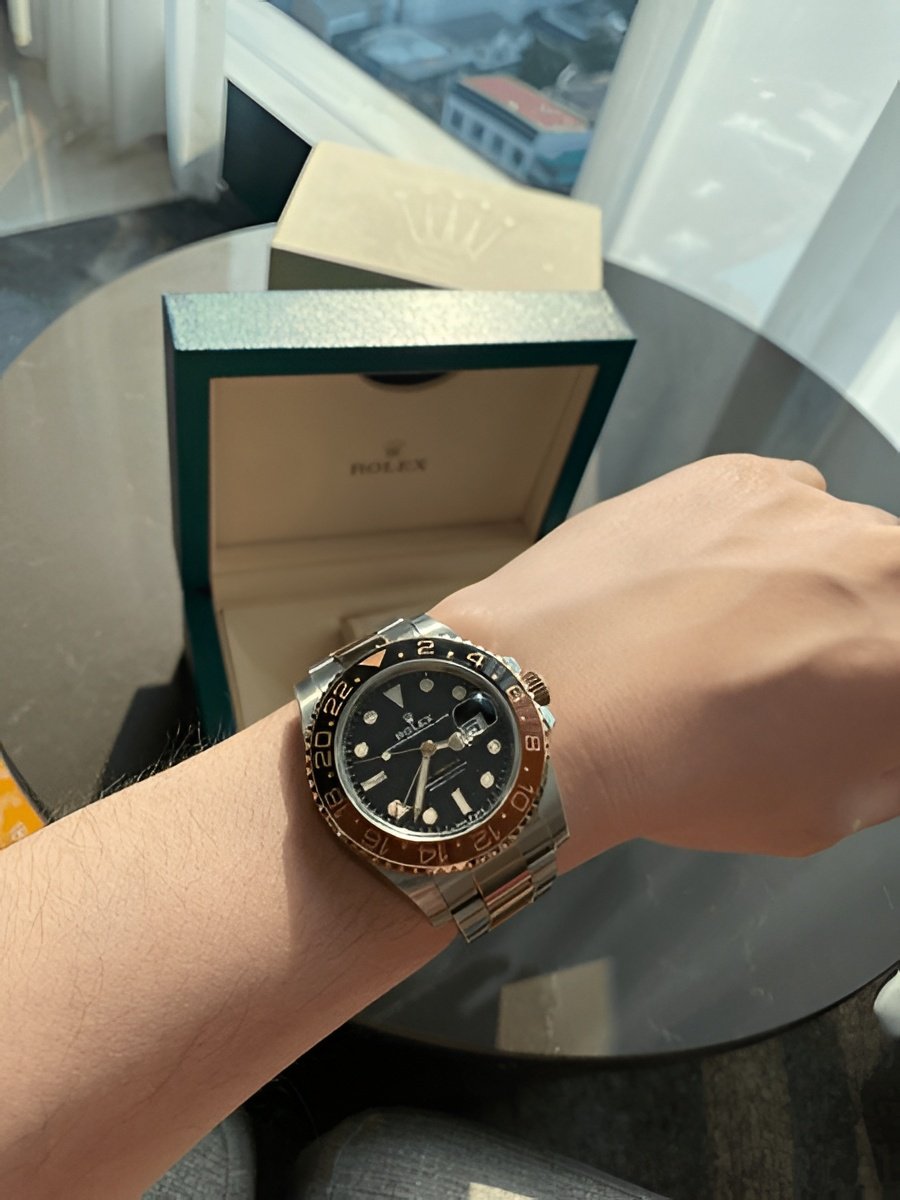
When the Premium Makes Sense — and When It Doesn't
On a Daytona, a Pepsi GMT, or a Submariner in genuinely clean condition, documentation compounds a premium that already exists. The next buyer will ask, and "watch only" is a harder conversation on a $15,000 watch than on a $7,500 one. Full papers on a Pepsi GMT can realistically add $2,000 or more. If you have any intention of reselling or trading up, buy with papers when you can find a clean example.
Older pieces are a different story. Nobody expects a 1988 Datejust to come with its original card. When one does it's a curiosity — genuinely interesting, marginally collectible, not meaningfully more wearable. The value at that age is case sharpness, dial originality, movement condition. Papers that most examples lost thirty years ago aren't part of the equation.
The entry-level problem is the one we see buyers wrestle with most. A $600 papers premium on a $7,500 watch is 8% of the purchase for something that doesn't change how the watch performs or feels on the wrist. We've watched buyers choose a papered example with a polished case over a watch-only piece with original surfaces because the documentation felt safer. It usually isn't. When a watch-only example is clearly the better watch, it's the better buy.
What Documentation Can't Do
The papers confirm who sold the watch new and when. That's it. What happened between that sale and today — whether the dial was redone, the case polished, the movement correctly serviced — none of that is in the card.
Every watch we take in gets the same process regardless of what comes with it. Movement out, timegrapher across positions, serial checked against production records, dial under magnification, case evaluated for polish. The paperwork is provenance. The inspection is what actually tells you what you're buying. We've passed on complete sets with refinished dials. We've bought watch-only pieces that were in better original condition than anything papered we'd seen in months.
If the watch-only example is the better watch, buy the watch.
Browse our current pre-owned Rolex inventory — every listing specifies documentation status and describes condition specifically. Still deciding which model? See our Rolex comparisons. Contact us directly for specific references. Looking to sell with or without papers? We buy pre-owned Rolex watches nationwide.