

I look at serial numbers before almost anything else when a watch comes across my desk. It's the fastest way to know roughly when a Rolex was made, whether it's consistent with the reference it's paired with, and whether the story someone's telling me about the watch actually holds together. Here's how the system works and what you can learn from it.
Where to Find It
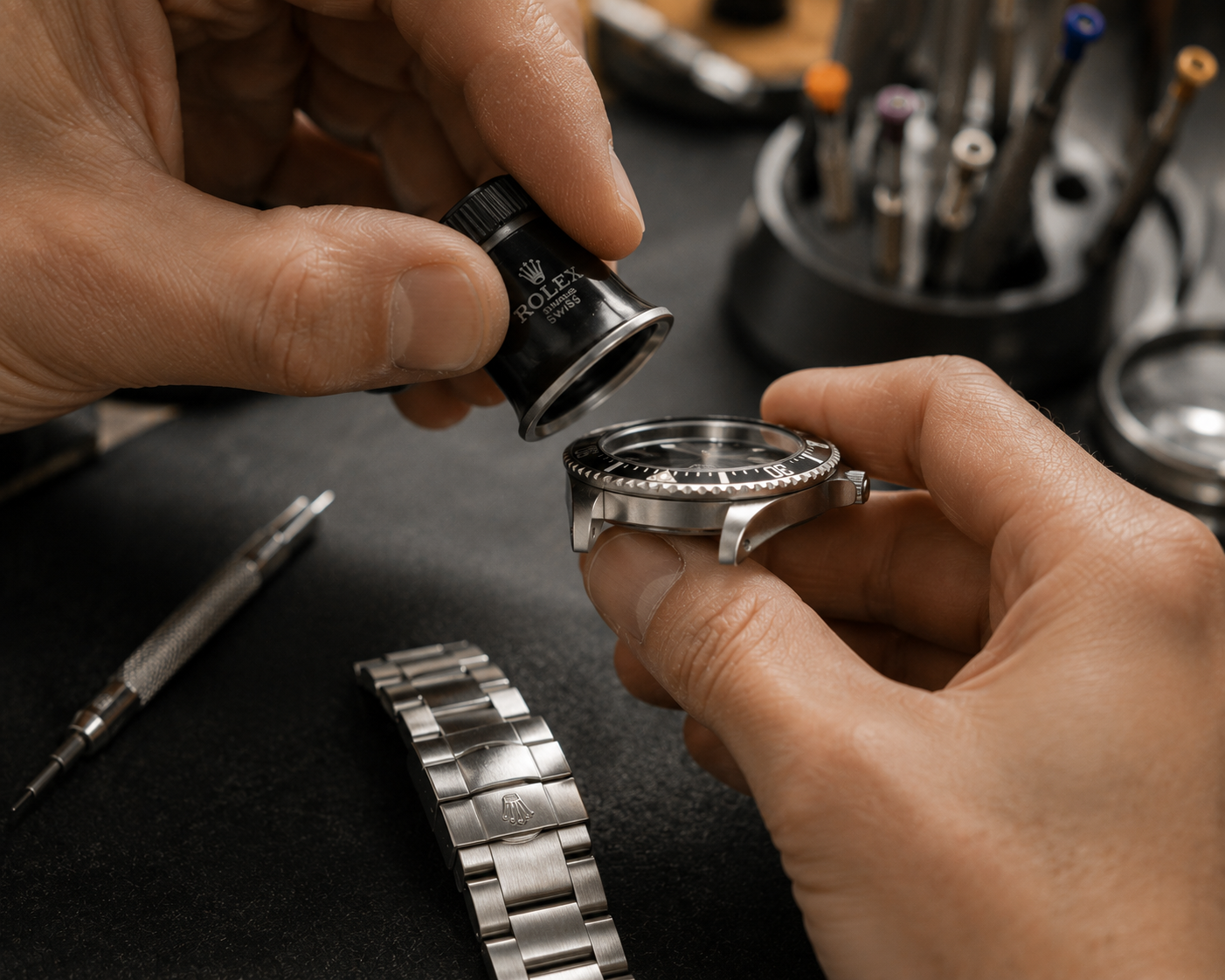
On most Rolex watches, the serial number is engraved between the lugs at 6 o'clock — the point where the bracelet attaches to the bottom of the case. You'll need to remove the bracelet or use a loupe at an angle to see it clearly on most references, since the engraving sits in a narrow recessed channel.
Current production (2010 and later) moved the serial number to the rehaut — the inner edge of the case, visible around the crystal when you look at the watch from certain angles without removing anything. Rolex made this change partly for security reasons, since it's harder to alter or grind off an engraving on the rehaut than one on the case exterior.
The reference number sits at 12 o'clock, in the same location pattern as the serial at 6. Together, these two numbers tell a specialist almost everything about a specific watch.
What the Numbers Actually Mean
Rolex serial numbers ran sequentially for decades, then switched to a randomized system in 2010. This matters practically: for watches made before 2010, the serial number correlates directly to production date — earlier numbers mean earlier watches, and reference tables exist that map serial ranges to approximate years.
For watches made after 2010, the randomized system means the serial number alone doesn't tell you the date. Instead, current-production watches carry a separate date code, and dating relies more on movement generation, dial characteristics, and other production details specific to when a given reference was manufactured.
Dating a Vintage Rolex
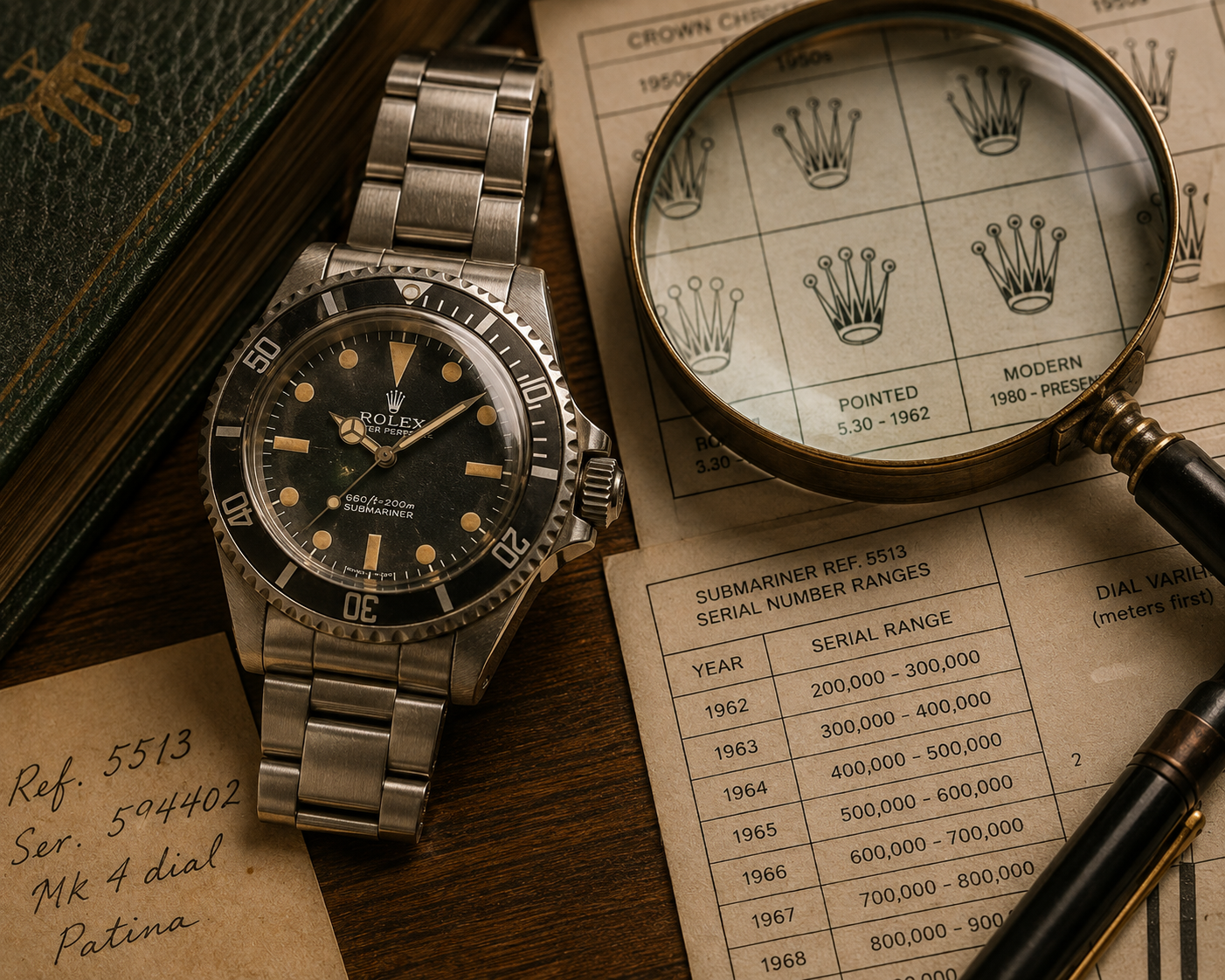
This is where serial numbers earn their keep. A five or six-digit serial number on a vintage piece narrows production to within a year or two once you cross-reference it against known ranges. This matters enormously for value — a 1966 Submariner with a gilt dial commands a very different price than a 1978 example with a matte dial, even though both might carry the reference 5513.
I use serial dating constantly to confirm that a dial configuration is actually correct for a watch's production period. If someone brings in a watch with a serial number suggesting 1970 production but a dial style that Rolex didn't introduce until 1974, that's an immediate flag — either the dial was replaced, or something else doesn't add up.
What It Can't Tell You
A serial number confirms approximate age and, combined with the reference number, tells you what the watch is supposed to be. It doesn't confirm the watch is genuine on its own, and it doesn't confirm the dial, hands, bezel, and movement are all original and correct for that specific watch.
Fakes sometimes carry serial numbers that are internally consistent — a real range for a real reference — because counterfeiters have gotten more sophisticated about details like this. The number is one data point in a full authentication process, not a standalone verification. I've seen watches with perfectly plausible serial numbers that turned out to have replaced movements or refinished dials, which the serial number alone would never reveal.
Franken-Watches and Why Serial Numbers Matter Here Specifically
A "franken-watch" is a Rolex assembled from parts of multiple genuine watches — a real case from one, a dial from another, a movement from a third. Each individual component might be authentic Rolex, but the watch as a whole isn't what it's being sold as, and it's worth significantly less than a correct, all-original example.
Serial number analysis is one of the primary tools for catching this. If the case serial dates to 1985 but the dial style, bezel configuration, or movement generation don't match what Rolex was producing in 1985, something has been swapped. This is exactly the kind of inconsistency that separates a straightforward purchase from an expensive mistake.
Using Serial Numbers When Buying Pre-Owned
Ask for the serial number before you commit to anything. Cross-reference it against production date tables — widely available online — and confirm it's consistent with the reference and dial configuration you're being shown. If a seller hesitates to provide it or the bracelet "can't be removed to see it," that hesitation tells you something on its own.
This is one piece of a full authentication process, not a replacement for one. On any purchase above a few thousand dollars, serial verification alongside dial inspection, movement testing, and case evaluation is what actually protects you.
Every pre-owned Rolex we sell at Ermitage Jewelers is authenticated using this full process — serial number verified against production records, dial and case evaluated by our in-house watchmaker, movement tested across positions. We've been doing this since 2000.
Browse our current pre-owned Rolex collection, or read our guide to spotting a fake Rolex for the complete authentication process beyond serial numbers alone. Looking to sell a Rolex? We buy pre-owned Rolex watches nationwide — the serial number is one of the first things we'll ask for.