

The bracelet decision gets less attention than the model decision, and that's a mistake. A Datejust 41 on an Oyster bracelet and a Datejust 41 on a Jubilee are genuinely different watches — different proportions, different wearing experience, different price on the pre-owned market. Get it wrong and you'll be swapping within a year.
We've been selling both long enough to know which configurations people keep and which ones they trade back in. Here's the actual difference.
What Each Bracelet Was Designed For

The Oyster bracelet came first — Rolex introduced it in 1931, three-link design, built for durability. Flat center links flanked by brushed outer links, solid end-pieces, a clasp that has evolved but never strayed far from the original. It was designed as a tool-watch bracelet: robust, water-resistant, comfortable in conditions where you're not thinking about your watch.
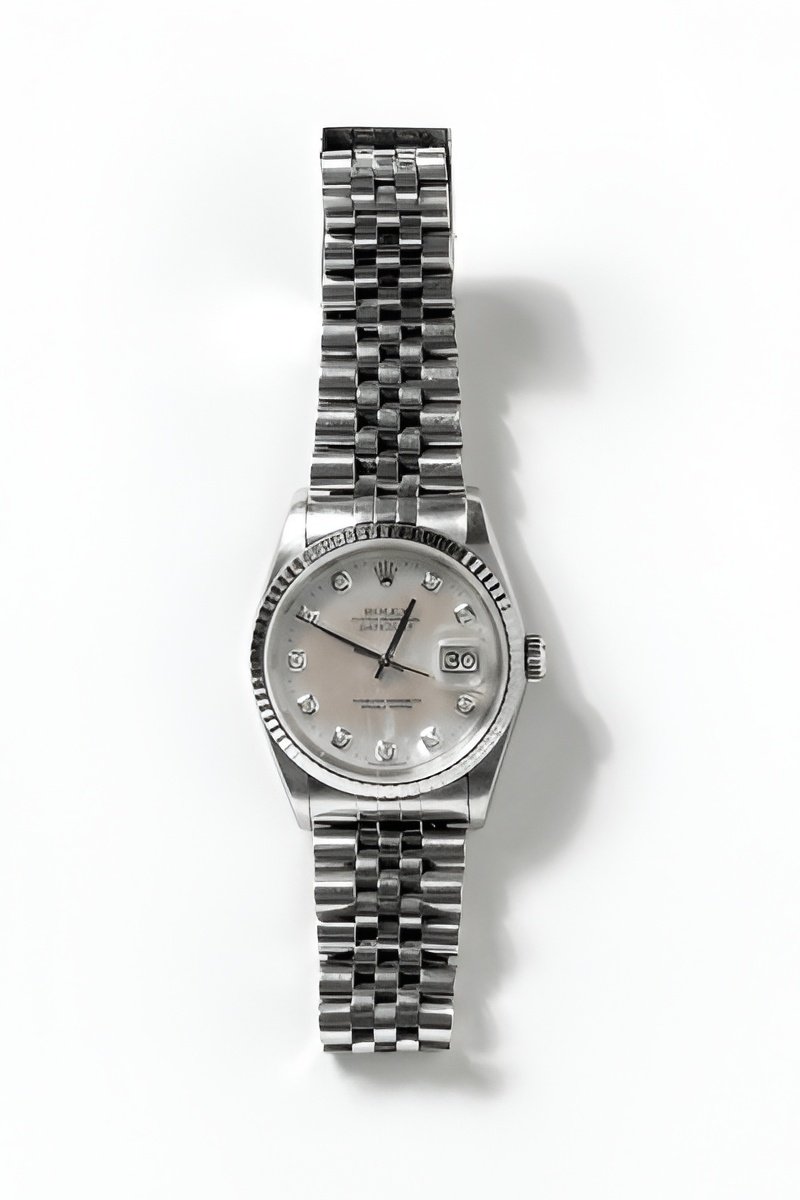
The Jubilee came out in 1945, developed specifically to accompany the original Datejust. Five links instead of three, narrower profile, more curved to follow the wrist. Rolex designed it as a dress bracelet — more refined, more flexible, more at home under a shirt cuff than on a dive boat. The name came from Rolex's 40th anniversary. It stuck because the bracelet worked.
Both are still in production. Both are available across most current references. The choice between them is not about quality — it's about character.
How They Wear
The Oyster is the more substantial bracelet. On a Submariner or GMT-Master II it's the obvious pairing — it matches the tool-watch brief of those models and wears cleanly in all conditions. On a Datejust it reads as sportier, more casual, the configuration you reach for when you're not trying to impress anyone.
The Jubilee drapes differently. Five links give it more flex points, which means it follows the wrist more naturally and sits closer to the skin. On a Datejust — which is what it was designed for — it's the more elegant choice. The watch moves with your wrist rather than sitting on top of it. Long-term Datejust owners who started on Oyster tend to end up on Jubilee eventually. The reverse is rare.
On the GMT-Master II the Jubilee has developed a specific reputation. The Pepsi on Jubilee in particular is considered by a lot of collectors to be the best-wearing GMT configuration Rolex has produced. It's not an obvious combination — a pilot's tool watch on a dress bracelet — but it works because the GMT's case is slimmer than the Sub's and the Jubilee balances it.
Wrist size matters here. The Jubilee tends to suit smaller wrists better — the narrower profile and flexibility make a 41mm case feel more proportionate. On a larger wrist the Oyster's solidity can read as more intentional.
Pre-Owned Pricing
On the pre-owned market the Jubilee consistently commands a premium over the Oyster on the same reference. For a Datejust 41, the difference is typically $500 to $1,000 — a Jubilee example in equivalent condition will price higher. On the GMT-Master II Pepsi, the Jubilee premium can reach $1,500 to $2,000 over the same reference on Oyster.
Part of this is demand. Part of it is condition — Jubilee bracelets show wear more visibly than Oyster bracelets, so a Jubilee in genuinely clean condition is harder to find. The five-link construction develops play between links over time, and a stretched Jubilee is immediately noticeable. An Oyster in similar hours of wear will look tighter.
When evaluating a pre-owned watch on Jubilee, check for bracelet stretch by holding the clasp and lifting — any significant lateral movement between links indicates wear. Budget $300 to $600 for bracelet replacement if it's needed; factor that into your offer.
Which One to Buy
On a Submariner: Oyster. The combination is correct and the Jubilee, while available, reads as an afterthought on a dive watch.
On a Datejust 36 or 41: depends on how you'll wear it. Daily wear in varied settings — Oyster. Predominantly dressed, office-to-dinner — Jubilee. If you're genuinely unsure, buy the Jubilee. Most people who try both end up there.
On a GMT-Master II: personal preference, but the Jubilee on a Pepsi or Batman is worth the premium if you can find a clean example. The Oyster on a GMT is perfectly correct and easier to find in better bracelet condition.
Browse our current pre-owned Rolex Datejust, Submariner, and GMT-Master II inventory — listings specify bracelet configuration. If you're looking for a specific reference and bracelet combination, contact us directly. We've been sourcing for clients since 2000 and know what's moving in the market before it hits the site. Looking to sell? We buy pre-owned Rolex watches nationwide.