

Two brands. Both Swiss. Both make watches that last decades. Both have been to the moon, the ocean floor, and the wrists of presidents. The Rolex vs Omega debate has been running since the 1960s and the answer has never been as simple as "one is better." When comparing Omega watches vs Rolex, the real question is what you're optimizing for — wearing experience, value retention, or both.
What is simple: they're built for different buyers at different price points with different ideas about what a watch should do. After 25 years of selling pre-owned Rolex watches and watching the Omega market alongside it, here's how we actually think about the comparison.
Rolex vs Omega: Which Is More Expensive?
Rolex is more expensive at every comparable tier. That's the short answer. Here's the longer one.
A steel Omega Seamaster 300M retails at approximately $5,700. A steel Rolex Submariner retails at $10,100. Nearly double.
An Omega Speedmaster Moonwatch retails at approximately $6,600. A Rolex Daytona retails at $16,550. More than double — and the Daytona trades pre-owned at $27,000 to $36,000 because authorized dealers can't meet demand.
An Omega Seamaster Aqua Terra retails around $6,400. A Rolex Datejust 41 retails at $9,100. Less dramatic but still a meaningful gap.
On the pre-owned market the spread changes. A pre-owned Seamaster 300M can be found at $3,200 to $4,500. A pre-owned Submariner runs $10,000 to $13,000. The Rolex holds a larger percentage of its retail price, which is part of the value proposition — and part of why it costs more going in.
The price difference between Omega and Rolex is not about one being twice as good. Both use in-house movements. Both are COSC-certified chronometers. Both build cases and bracelets from 904L (Rolex) or 316L (Omega) steel to standards that exceed what the price difference suggests. What you're paying for with Rolex is brand positioning, secondary market value retention, and controlled production that keeps demand ahead of supply.
Movement and Technology
This is where the comparison gets interesting because Omega has genuinely closed the gap.
Omega's co-axial escapement — developed by George Daniels and adopted by Omega in 1999 — reduces friction in the movement in a way that conventional Swiss lever escapements don't. Their Master Chronometer certification, tested by METAS (the Swiss Federal Institute of Metrology), requires watches to perform within 0 to +5 seconds per day and withstand magnetic fields up to 15,000 gauss. That's a tighter tolerance than COSC and a dramatically higher magnetic resistance than Rolex specifies.
Rolex's Chronergy escapement, introduced in the caliber 32xx series, improved efficiency by 15 percent over previous generations and extended power reserve to 70 hours. Rolex's Superlative Chronometer certification tests to ±2 seconds per day — tighter on paper than COSC but not directly comparable to METAS because the testing methodologies differ.
Both brands make excellent movements. Omega's anti-magnetic capability is genuinely superior. Rolex's movements have a longer track record and parts availability for service is better across most markets. For practical daily wearing, the difference in performance is negligible.
Omega Seamaster vs Rolex Submariner
The dive watch comparison that drives most Rolex vs Omega conversations.
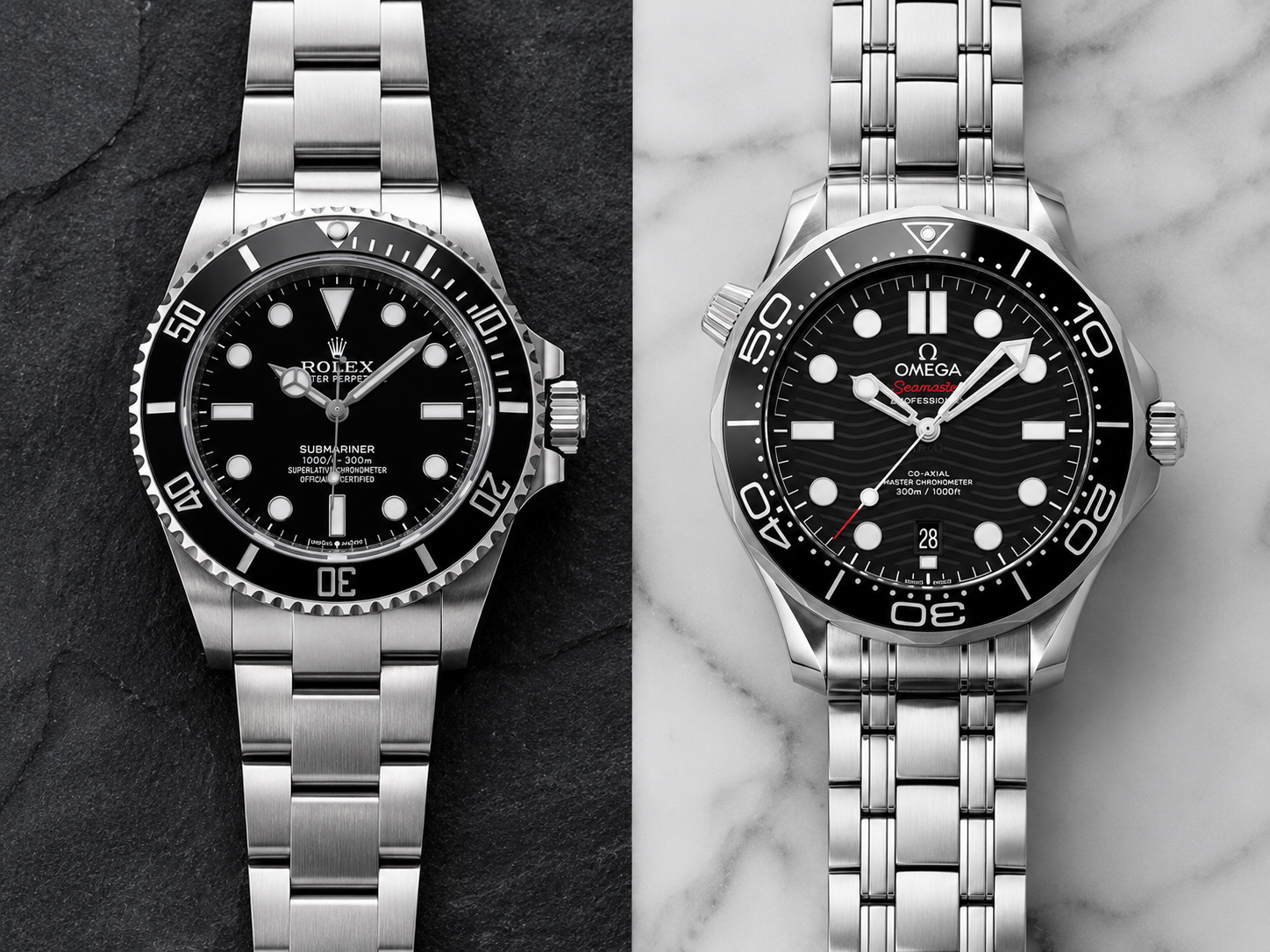
The Seamaster 300M is a 42mm dive watch rated to 300 meters. Ceramic bezel, helium escape valve, available on bracelet or rubber strap. Co-axial Master Chronometer movement with 55-hour power reserve. Retail: approximately $5,700. Pre-owned: $3,200 to $4,500.
The Rolex Submariner is a 41mm dive watch rated to 300 meters. Ceramic bezel, Oyster bracelet, caliber 3235 with 70-hour power reserve. Retail: $10,100 (no date) to $11,550 (date). Pre-owned: $10,000 to $13,000.
The Seamaster is a better deal on paper. More watch per dollar, superior anti-magnetic spec, available at retail without a waitlist. The Submariner holds value better, has stronger brand recognition, and carries a secondary market premium that the Seamaster doesn't.
Which you should buy depends on what you value. If the watch is primarily something you'll wear, the Seamaster gives you more for less. If the watch is also a store of value and you care about resale, the Submariner's secondary market depth is unmatched. The Omega Seamaster vs Rolex Submariner comparison usually comes down to whether you're buying a watch or buying an asset that happens to tell time.
Omega Speedmaster vs Rolex Daytona
The chronograph comparison is more lopsided than the dive watch one.
The Omega Speedmaster Moonwatch — the watch NASA selected for the Apollo program — is one of the most historically significant timepieces ever made. Manual-wind, 42mm, hesalite crystal on the standard reference. Retail: approximately $6,600. Pre-owned: $4,000 to $5,500.
The Rolex Daytona is a self-winding chronograph with a column wheel mechanism, ceramic bezel, and a movement (caliber 4130) developed specifically for this reference. Retail: $16,550. Pre-owned: $27,000 to $36,000.
The Speedmaster has the better story. First watch on the moon. Selected by NASA over Rolex, among others, in competitive testing. That history is irreplaceable. The Daytona has the better market: pre-owned prices that exceed retail by 60 to 100 percent, demand that authorized dealers cannot meet, and a collector base willing to pay significant premiums for specific configurations.
If history and heritage matter more than market performance, the Speedmaster at $6,600 is one of the best values in Swiss watchmaking. If market position and resale matter, the Rolex Daytona vs Omega Speedmaster comparison isn't close — the Daytona wins on every financial metric.
Value Retention: Omega vs Rolex
This is where the Omega vs Rolex gap is largest and most consistent.
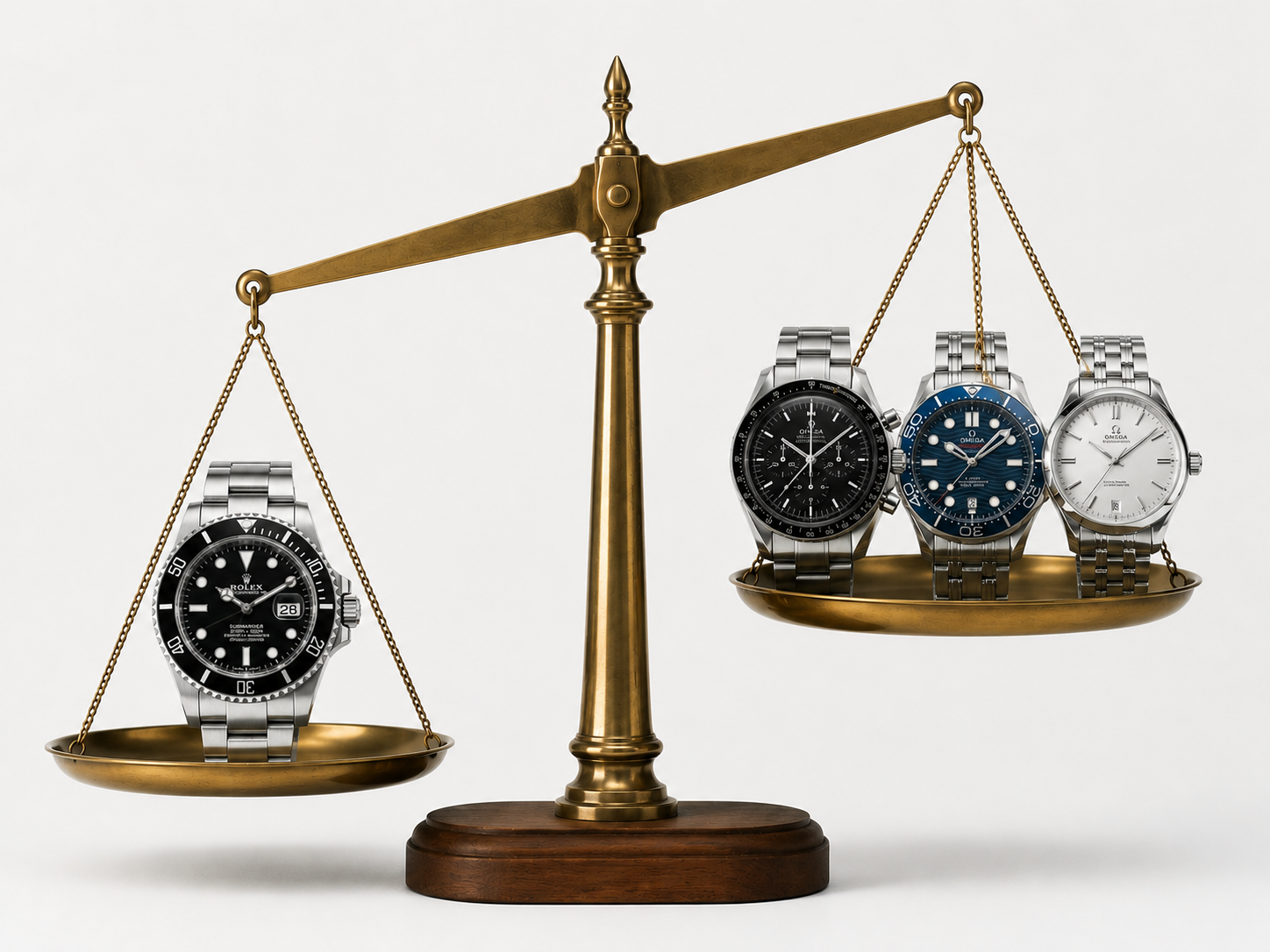
A Rolex Submariner purchased at retail for $10,100 trades pre-owned at $10,000 to $13,000. You lose nothing — and on many references you gain. A five-year-old Submariner in clean condition often sells for more than what was originally paid.
An Omega Seamaster purchased at retail for $5,700 trades pre-owned at $3,200 to $4,500. You lose 20 to 45 percent. That's normal for luxury watches — most brands depreciate — but the contrast with Rolex is stark.
The reason isn't quality. Omega makes watches that compete with Rolex on specification. The reason is supply management. Rolex controls production more tightly than Omega, creates scarcity on the most desirable references, and has built a secondary market ecosystem where demand consistently exceeds supply. Omega produces more watches, distributes more widely, and discounts more frequently through authorized dealers — all of which are good for the buyer at purchase and bad for the buyer at resale.
Which Should You Buy?
Buy the Omega if you want the best watch per dollar spent. The Seamaster 300M at $5,700 is a better-specified dive watch than the Submariner by most objective measures. The Speedmaster at $6,600 is one of the most historically significant watches you can buy at any price. Omega watches are available at retail without waitlists, and the entry point to the brand is roughly half of Rolex.
Buy the Rolex if secondary market value matters, if brand recognition matters, or if you want a watch that functions as both a wearing piece and a financial asset. The premium over Omega is real, but so is the value retention that justifies it over time.
The buyers who end up happiest with the Omega vs Rolex decision are usually the ones who bought whichever watch they actually wanted rather than the one the internet told them to buy. Both brands make watches that last decades. Both will still be running long after the debate ends.
Browse our current pre-owned Rolex collection — Submariner, Daytona, GMT-Master II, and more. Every watch authenticated, inspected, and warranted since 2000. For current pricing across all models, see our Rolex Price Guide 2026. Looking to sell? We buy pre-owned Rolex watches nationwide.