

I check pre-owned Rolex prices every week — not as research, just as part of running this business. You notice patterns that don't show up in any single sale. Here's what 2026 actually looks like from where I sit, not from a spreadsheet built by someone who's never bought a watch off a seller's wrist.
The Correction Is Over. Mostly.
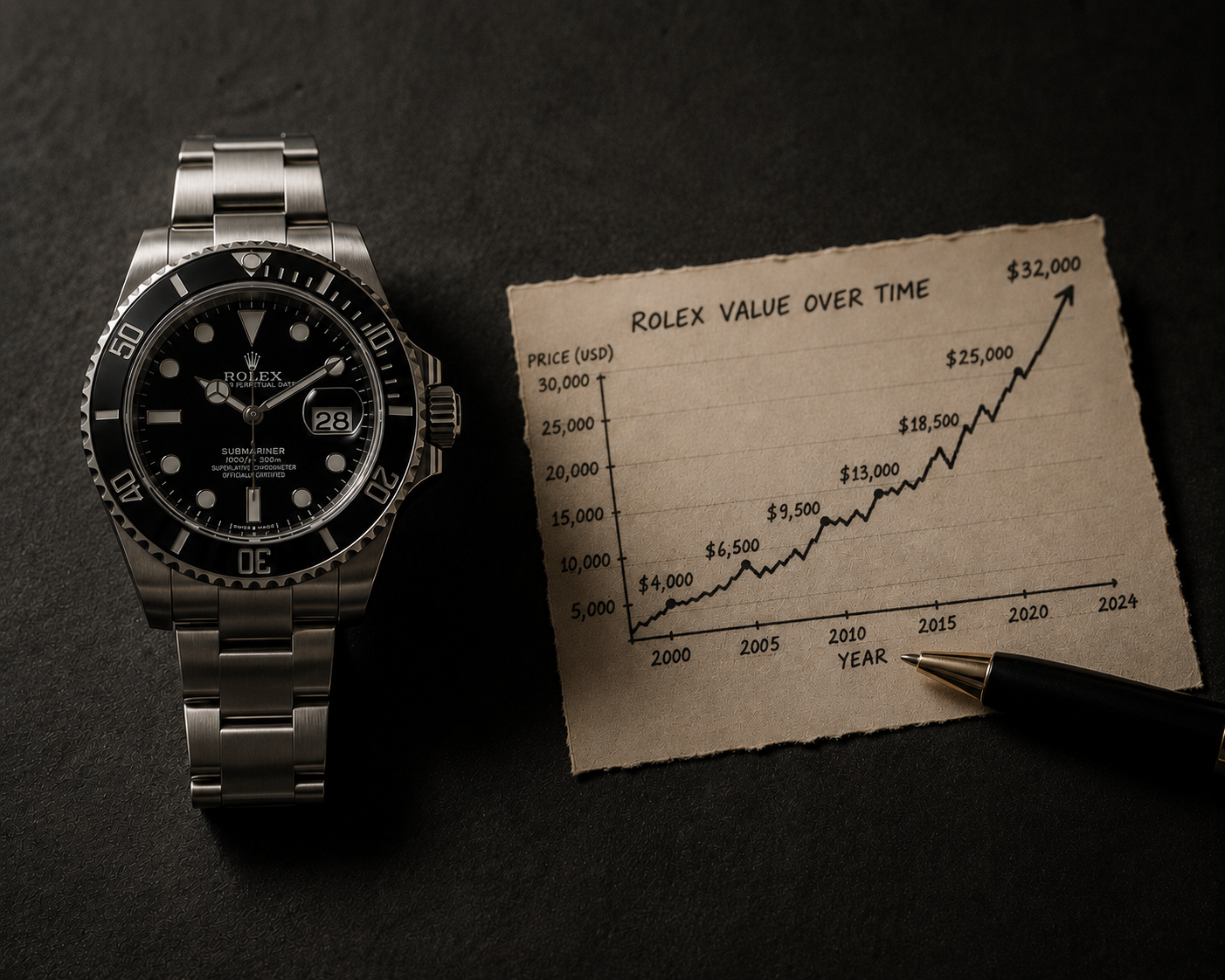
The 2021-2022 speculative peak and the correction that followed through 2023 get talked about like they're still happening. They're not, not really. Most references settled into a stable range by late 2024 and have held there with normal seasonal movement since. The steel Submariner that was $15,000 at the 2021 peak and $11,500 during the 2023 low is sitting at $10,000 to $13,000 now — which, if you do the math, is almost exactly where it was before the speculation started. The market didn't crash. It overshot and came back.
What's actually new in 2026 isn't correction. It's discontinuation-driven repricing, and that's a different animal entirely.
Discontinuations Are Doing More Work Than Anything Else Right Now
Rolex pulled the GMT-Master II Pepsi and the Cookie Monster from production at Watches & Wonders this year. That's the single biggest price event of 2026 in this market, full stop. The Pepsi was already trading $16,000 to $19,000 against a $12,750 retail — a premium that existed because ADs couldn't meet demand. Discontinuation removed the retail anchor entirely. Post-announcement, clean examples on Jubilee are running $19,000 to $22,000, and I don't think that's finished moving.
I've watched this pattern before. The Hulk Submariner got pulled in 2020 and did almost exactly this: a fast bump in the months after, some pullback as early sellers took profit, then a settle at a level meaningfully above where it started. Prices didn't peak and crash. They found a new floor and mostly stayed there. If the Pepsi follows the same script — and so far it is — the current $19,000 to $22,000 range is closer to a floor than a ceiling.
Vintage Is Quietly the Strongest Category
Nobody's talking about this as loudly as they should be. While sport references get the attention, vintage Rolex — genuinely vintage, 1960s through 1980s — has had the most consistent upward pressure of any category over the past two years. A clean vintage Submariner (5513, 1680) or GMT (1675) in honest original condition is worth meaningfully more today than it was in 2024, and the gap between an original-dial example and a refinished one has widened, not narrowed.
Part of this is generational — buyers who grew up on modern ceramic Rolex are discovering that vintage acrylic-crystal watches have a character the current lineup doesn't, and they're willing to pay for it. Part of it is simple scarcity: every year, the supply of genuinely unpolished, original-dial vintage watches shrinks, because it can only shrink. Nobody's making more 1960s Submariners.
Gold Is Repricing With the Metal, Not Against It
Gold spot prices moved up significantly through 2025 into 2026, and Rolex references in gold — the Day-Date especially — have tracked that move closely. This isn't a Rolex story, it's a gold story that happens to include Rolex. A yellow gold Day-Date that traded at $22,000 two years ago reflects both the brand premium and a meaningfully higher gold floor now.
What this means practically: gold Rolex references are less volatile on the Rolex-specific side of the equation right now, because the metal price is doing a lot of the work. If gold pulls back, expect Day-Date and other precious-metal references to soften with it regardless of what collector demand is doing.
What's Flat, and Why That's Not a Bad Thing
Entry-level references — the Oyster Perpetual, the Air-King, most Datejust configurations — have been genuinely flat for two years. No speculation, no discontinuation drama, no gold correlation. Just steady demand from buyers who want a real Rolex without playing the reference-specific game the sport watches invite.
I'd argue flat is actually the correct, healthy state for these watches, and the sport reference volatility is the anomaly, not the other way around. A Datejust 36 holding $4,500 to $8,500 for two straight years tells you the market for that watch is functioning normally — buyers and sellers agreeing on value without speculation distorting it.
The Daytona Keeps Doing What It's Always Done
Steel Daytona pricing — $27,000 to $36,000 pre-owned against a $16,550 retail — hasn't moved dramatically in either direction this year, and I don't expect it to. This is the most structurally stable premium in the entire Rolex catalog because the supply constraint that created it hasn't changed and shows no sign of changing. Every prediction I've heard about the Daytona premium finally collapsing has been wrong for over a decade. I'd bet against it collapsing in 2026 too.
What I'm Actually Watching Going Into the Rest of the Year
Whether the Pepsi settles where the Hulk did, proportionally, or overshoots further. Whether Rolex discontinues anything else at a future event — there's always speculation about which reference is next, and I don't put much stock in guessing games, but the market reacts fast when it happens. And whether gold keeps climbing, because if it does, every precious-metal Rolex reference gets a floor that has nothing to do with watch collecting at all.
None of this is investment advice. It's just what the transactions in front of me are actually showing, week over week, in a market I've been part of since 2000.
For current pricing across specific models, see our Rolex Price Guide 2026. For the full story on this year's biggest price event, read our Pepsi GMT discontinuation analysis. Thinking about which references hold value best long-term? Our Rolex investment guide covers that in more depth. Browse our current pre-owned Rolex collection or sell your Rolex at today's market price.