

Every dealer gets the same question eventually: which dial color should I get? Most guides answer with wardrobe advice — black goes with everything, blue is versatile, green makes a statement. That's true and also useless if you're spending five figures on a watch. Here's the version of this conversation that actually matters: which colors hold value, which appreciate, and which are just a personal preference with no financial upside either way.
Black — The Baseline
Black is the color against which everything else gets measured, and it's priced accordingly. A black-dial Submariner or Datejust trades at standard market rates for the reference with no color premium attached in either direction. It's not boring because it's common; it's common because it's correct on more references than any other color, and the market treats it as the neutral default.
If you're buying your first serious Rolex and don't have a strong color preference, black removes one variable from a purchase that already has plenty of others.
Blue — Popular, But Which Blue Matters
Blue dials range from a near-black midnight blue to the bright "smurf" blue on the white gold Submariner (116619LB), and the value implications vary enormously across that range. Standard blue dials on the Datejust or Submariner trade close to black — a small premium at most, usually under 5 percent.

The exception is the ice-blue dial, which Rolex reserves exclusively for platinum cases. You cannot get ice-blue on steel or gold at any price — it's Rolex's way of signaling its most exclusive metal, and the color itself has become shorthand for "this watch is platinum" among people who know the catalog. A platinum Day-Date with ice-blue trades at $45,000 to $60,000+, and part of that price is the fact that the color simply isn't available anywhere else in the lineup.
Green — Rare by Design, Priced Accordingly
Rolex uses green sparingly, which is precisely why it commands real premiums. The Hulk Submariner (116610LV) — green dial, green bezel — was discontinued in 2020 and now trades at $11,000 to $13,500, meaningfully above comparable black-dial Submariners. The green isn't incidental to that price; it's the entire reason collectors seek this specific reference out.
The "Wimbledon" Datejust — deep ivy-green with Roman numerals, named for the grass courts at the All England Club — commands a similar collector premium on the Datejust 41, trading at $9,500 to $13,000 against a standard black-dial example running $1,500 to $2,000 less.
White — Underrated in the Data
White dials get less attention than black or blue in most buying conversations, but they carry a specific advantage: they photograph and read cleaner under most lighting, which matters more than people expect on the secondary market where buyers are shopping from photos. A white-dial Explorer II has historically traded at a small premium over black for exactly this reason — visual distinctiveness in a catalog where most sport watches default to dark dials.
The Colors That Actually Appreciate: Discontinued Oyster Perpetual Dials
This is where the real money is, and most buying guides skip it entirely because it requires tracking production history rather than describing aesthetics.
Rolex has introduced and discontinued a series of bold Oyster Perpetual dial colors over the past decade — turquoise, coral red, bright yellow, and a candy-pink among them. While in production, these traded close to retail. Once discontinued, each one has appreciated meaningfully: turquoise and coral red Oyster Perpetuals now trade well above what other, still-produced dial colors on the same reference command, sometimes by $1,000 or more depending on size and condition.
The mechanism is straightforward. Rolex controls supply on everything, but a discontinued color has a supply ceiling that can only shrink from here — no more are coming, ever, on that specific reference generation. Buyers who want that exact color have exactly one place to look, and prices reflect it.
Stella Dials — The Vintage Color Story
Vintage Rolex collectors know "Stella" dials as a specific and expensive category: lacquered dials in vivid colors — orange, yellow, green, red, blue — produced in small numbers primarily in the 1970s for references like the Day-Date. These are genuinely rare, genuinely fragile (the lacquer chips and fades in ways that affect value significantly), and command prices far above a standard metal-dial example of the same reference and era. A clean Stella dial Day-Date can trade at a substantial multiple of its standard-dial counterpart, and condition matters enormously given how easily the lacquer degrades.
This is the clearest example in the entire Rolex catalog of dial color functioning as the primary value driver rather than a secondary preference. Two otherwise identical watches, one worth several times the other, purely on dial.
Tropical Dials — When "Damage" Becomes the Point
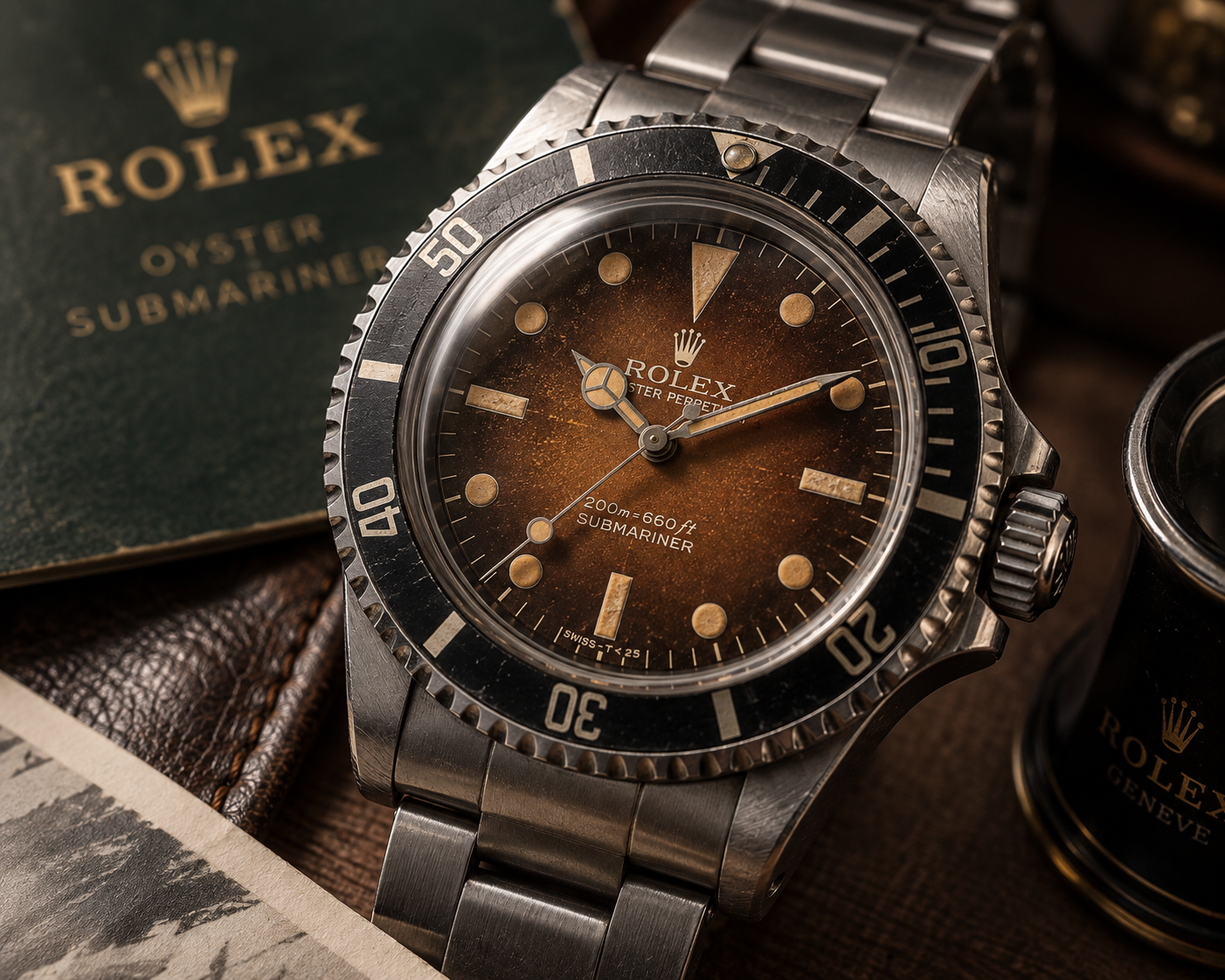
Vintage black dials that have faded to brown from decades of UV exposure are called "tropical" dials, and rather than being treated as damage, they've become one of the most actively sought conditions in vintage collecting. A tropical dial on a vintage Submariner or GMT-Master isn't a flaw to discount — it's a feature that can add a meaningful premium over an unfaded example, provided the fade is even and the watch is otherwise original.
This is the one place in the entire dial conversation where deterioration increases value rather than decreasing it, and it's worth understanding before you assume every color change on an old watch is a problem.
What This Means When You're Buying
If value retention matters to your decision, buy on the merits above rather than personal taste alone. Black and standard blue are safe and liquid but carry no upside. Green on the right reference, discontinued Oyster Perpetual colors, and — for the patient, well-funded buyer — vintage Stella and tropical dials are where color choice becomes a genuine financial decision rather than a wardrobe one.
If value retention doesn't matter and you're buying to wear something you love looking at every day, none of this should override your own taste. The watch you actually enjoy wearing is worth more to you than the one that's theoretically worth more on paper.
Browse our current pre-owned Rolex collection across dial colors and configurations, or see our Rolex Price Guide 2026 for current pricing by reference. Looking to sell a Rolex with a notable dial? We buy pre-owned Rolex watches nationwide and price based on current market conditions, including dial-specific premiums.