

The Rolex Pepsi is the single most searched Rolex reference on the internet. More people look for it than the Submariner, more than the Daytona, more than any other configuration in the lineup. The red and blue ceramic bezel on a steel GMT-Master II became the watch that defined what a modern collector's Rolex looks like — and then Rolex discontinued it.
If you're looking for a Pepsi Rolex in 2026, you're buying pre-owned. The Rolex Pepsi is no longer available at authorized dealers. Here's everything you need to know about buying one on the secondary market.
Why It's Called the Pepsi
The nickname goes back to the 1970s. Collectors noticed that the red and blue bezel on the GMT-Master matched the Pepsi-Cola logo closely enough to stick. Rolex never used the name officially — they don't name watches after soft drinks — but authorized dealers, auction houses, and the brand's own marketing team eventually stopped pretending the nickname didn't exist. For the full story behind this and other Rolex nicknames, see our Rolex nicknames guide.
The original Pepsi GMT was the reference 6542, introduced in 1955 for Pan American Airways. Pilots needed to track two time zones simultaneously: home time on the 24-hour bezel and local time on the main dial. The red half represented daytime hours, blue represented nighttime. Functional logic that happened to look like a soda logo.
The Rolex Pepsi GMT Through the Generations
The Pepsi bezel has appeared across four generations of the GMT-Master and GMT-Master II. Each Pepsi Rolex reference plays differently on the pre-owned market.
Reference 6542 (1955–1959) — The original. Bakelite bezel insert on early examples, aluminum on later ones. No crown guards. This is a vintage collector piece, not a daily wearer. Clean examples with original bezels: $15,000 to $40,000+ depending on condition and provenance.
Reference 1675 (1959–1980) — The long-running classic. Crown guards added, aluminum bezel insert. Produced for over twenty years, which means enormous variety in the pre-owned market. Clean examples: $8,000 to $18,000. Faded bezels on well-worn pieces have their own collector following — the "ghost" Pepsi bezel, where the colors have softened to pink and light blue, commands premiums on the right examples.
Reference 16710 (1989–2007) — The last Pepsi with an aluminum bezel. Caliber 3185 with a quickset GMT hand. This is the reference that many long-term collectors consider the sweet spot: modern enough to wear daily, vintage enough to appreciate. Clean examples with original bezel inserts: $10,000 to $16,000.
Reference 126710BLRO (2018–2026) — The ceramic Pepsi. Rolex reintroduced the red and blue colorway on a ceramic bezel insert in 2018 after an 11-year absence. Available on Jubilee or Oyster bracelet, running the caliber 3285 with a 70-hour power reserve. This is the reference that reignited Pepsi demand to levels that exceeded anything in the watch's history.
Discontinued at Watches & Wonders 2026. No longer in production. We cover the full discontinuation analysis and what it means for buyers separately.
Rolex Pepsi Price Guide 2026
The Pepsi Rolex price depends on reference, bracelet, condition, and documentation. Post-discontinuation, Rolex Pepsi prices on the 126710BLRO are still finding their level. Here's what the market looks like right now.
126710BLRO on Jubilee, with papers: $19,000 to $22,000 126710BLRO on Jubilee, watch only: $16,000 to $19,000 126710BLRO on Oyster, with papers: $15,000 to $18,000 126710BLRO on Oyster, watch only: $13,000 to $16,000
16710 Pepsi, clean original bezel: $10,000 to $16,000 1675 Pepsi, honest condition: $8,000 to $18,000 6542, collector grade: $15,000 to $40,000+
The Jubilee bracelet commands a consistent $2,000 to $3,000 premium over the Oyster on the 126710BLRO. This gap has held since the reference was introduced and widened slightly after discontinuation. If you're buying with any thought toward future value, buy the Jubilee.
Papers add $2,000 to $3,000 on the 126710BLRO — more than on most Rolex references because documentation matters more on watches trading well above retail. The next buyer will ask. For pricing across all models, see our Rolex Price Guide 2026.
Jubilee vs Oyster on the Pepsi
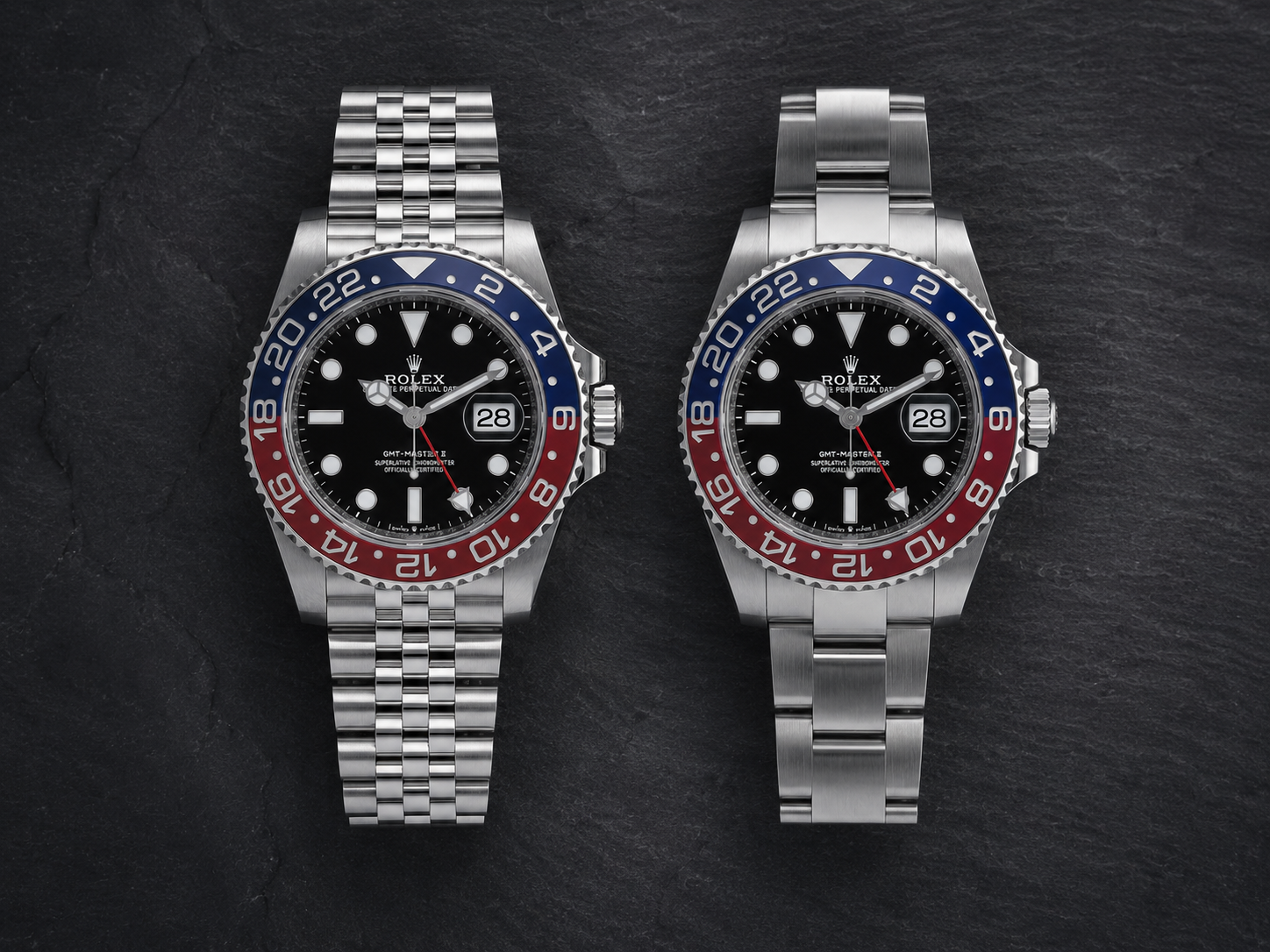
The Pepsi GMT on Jubilee is the configuration that changed the market. When Rolex reintroduced the Pepsi in 2018 on a Jubilee bracelet — a combination the brand hadn't offered on the GMT line in decades — it became the most requested watch in the Rolex catalog overnight.
The Jubilee on the Pepsi Rolex works because the GMT case is slimmer than the Submariner. The five-link bracelet adds a visual refinement that the Oyster doesn't. It's a pilot's tool watch wearing a dress bracelet, and somehow the contradiction produces one of the most visually balanced Rolex configurations ever made.
The Oyster is the sportier, more understated option. It's also easier to find in better bracelet condition — Jubilee bracelets stretch more visibly with wear, and a clean Jubilee is harder to source than a clean Oyster. If bracelet condition matters and you don't want to budget $400 to $600 for replacement, the Oyster is the practical choice.
Why the Pepsi Was Discontinued
Rolex confirmed the discontinuation at Watches & Wonders 2026. The production challenge was always the two-color ceramic bezel — manufacturing a single ceramic insert with two distinct colors while maintaining Rolex's quality tolerance is technically demanding. The rejection rate on Pepsi bezels was reportedly higher than on single-color inserts.
Combined with whatever strategic decisions Rolex makes about lineup management — decisions the company never explains publicly — the result is that the most iconic GMT bezel configuration is no longer in production.
The historical pattern after Rolex discontinuations is consistent: prices move up 10 to 20 percent in the first months, settle slightly as early profit-taking occurs, then stabilize above pre-discontinuation levels and continue rising as supply contracts. The Hulk Submariner followed this pattern exactly after 2020. The Rolex Pepsi GMT is following it now.
What to Check on a Pre-Owned Rolex Pepsi
Buying a Rolex Pepsi watch pre-owned requires the same checks as any high-value Rolex — plus a few specific to this reference.
The two-color bezel is the first thing to examine. On the 126710BLRO, the ceramic should show a clean, precise transition between red and blue with no color bleeding at the boundary. The color should be consistent across the full insert — check under good light from multiple angles.

The bezel action should be smooth with distinct clicks and no lateral play. A bezel that wobbles when locked indicates a worn mechanism.
Dial printing should be sharp and consistent. The Rolex coronet at 12, the GMT-Master II text, the Superlative Chronometer designation — all should be crisp under magnification. The micro-etched coronet at 6 o'clock on the crystal should be visible under a loupe.
On the Jubilee bracelet, check for stretch between links. Hold the clasp and lift — lateral movement indicates wear. A stretched Jubilee on a Pepsi is a bigger problem than on other references because the bracelet is a significant part of the configuration's value.
The GMT hand — the arrow-tipped fourth hand — should advance independently when the crown is pulled to the first position. This confirms the quickset function works correctly.
Rolex Pepsi for Sale
Every pre-owned Rolex Pepsi GMT at Ermitage Jewelers has been authenticated, inspected, and warranted. We carry the 126710BLRO and earlier Pepsi references as they become available — discontinued references move through our inventory faster than current production.
See our full pre-owned Rolex collection or read our Pepsi GMT discontinued analysis for context on how the discontinuation is affecting the market. For current pricing across all Rolex models, see our Rolex Price Guide 2026.
Looking to sell a Pepsi GMT? We buy pre-owned Rolex watches nationwide and price based on current post-discontinuation market conditions. Contact us directly for a quote.